Weapons
Weapon styles
Although all weapons are used with a slightly different technique, many weapons are similar so if one can be used effectively another can be used unskilled (1d8) but at the same bonus. Each weapon belongs to a category and training for one weapon confers benefits to others in the same category. This does not apply to the oddity category.
The categories are:
|
Light crossbow |
Two Handed Sword
Bastard Sword
Arming Sword |
Flanged Mace |
|||||||||||
|
Dwarf axe |
Morning Star Flail |
||||||||||||
|
Battle-axe |
Alternative pollaxe |
||||||||||||
|
War Hammer |
|||||||||||||
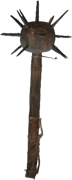
Morning star |
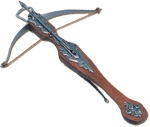

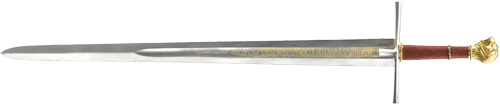
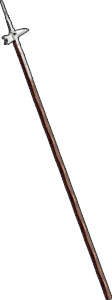
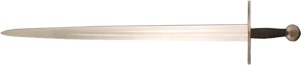
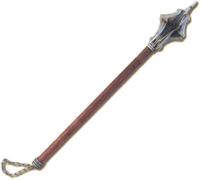
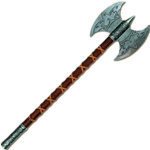
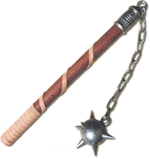
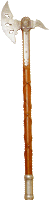


For each size of creature the damage level and minimum strength requirement is adjusted by their size.
Weapon Types
Daggers
Comprises two skill types that may be used at -2 for the unskilled type:
- Daggers, stilettoes and knives
- Short swords
Swords
Each sword is a different type but may be used at -2 for the unskilled types.
Hand weapons
Comprises 3 basic skill types that may be used at unskilled (1d8).
- Mace / Club / Morning star
- War hammer
- Battle-axe
2 Handed axes
Each is a different type but may be used at -2 for the unskilled type
- Viking axe
- Dwarf Axe
Pole arms
Pole arms are all different but may be used at -2 for an unskilled type
- Pollaxe
- Halberd
- Glaive
Oddities
All are very different requiring individual training.
- Flails
- Trident & Net
- Discus
- Sling
- Spear
- Touch
- Quarterstaff
Bows
Hand bows are different but may be used at -2 for an unskilled type.
- Horse bows (The bow previously known as short bow)
- Long bows
2 handed crossbows all count as the same skill, the other crossbow type may be used at -2 skill.
- Light crossbow, Heavy crossbow
- Pellet crossbow
Crossbows vs handbows may be used as if unskilled (1d8)
Hurled tumbling
These are all different but may be used as unskilled (1d8).
- Axes
- Hammer
- Throwing dagger
- Club
Hurled streamlined
These are all similar and may be used at -2 for an unskilled type.
- Spear
- Javelin
- Dart
Hurled oddities
This is a single skill type.
- Grenades
Damage
The maximum and average damage from a weapon rises as your ability increases.
| Weapon |
Damage |
Level |
|---|---|---|
| Staff | d2 |
1 |
Dagger |
d3 |
2 |
| Spear (1 hand) | d4 |
3 |
| Short sword | 2d4 |
4 |
| Falchion, Arming sword | d6/d4 |
5 |
| Scimitar / Sabre | d8/d4 |
6 |
d8/d6 |
7 |
|
d10/d6 |
8 |
|
d10/d8 |
9 |
|
d12/d8 |
10 |
|
d12/d10 |
11 |
|
2d12 |
12 |
|
| 2d12+d2 |
13 |
|
| 2d12+d4 |
14 |
|
| 2d12+2d4 |
15 |
Missile weapons do not increase in damage as you get more skillfull
After all deductions for armour, saving throws etc 1 /10 of all damage in a single blow (rounded down) is taken as wound points instead of stamina points.
Weapon Fighting Styles
There are three types of weapon
- Cutting (e.g. swords)
- Bludgeon / Chop (e.g. maces, hammers, clubs / axes, some heavy swords)
- Thrust / pierce (e.g. spears, daggers / arrows)
- Cut
- drawing a sharp edge across the body
- Chop
- Heavy blade normally with a curved edge to focus the force on a small area
- Bludgeon
- Lump of metal/wood... Spreads the impact more than chop but less likely to slip with a glancing blow against angled armour (+3 to hit plate).
- Thrust
- Pointy but with continued force applied (includes rear facing pointy bits on pollaxes... )
- Pierce
- Pointy and a missile
If a weapon has more than one mode you may use either mode at will.
Different weapons are differently effective against an armour type, for example mail will stop completely a normal sword blow from cutting you, however in doing so some of the cutting damage is converted to blunt trauma as the impact jellifies your internal organs. A hard shell however such as boiled leather is better against blunt weapons as the force is spread out more, however a cutting weapon will go straight through it.
Although the bigger heavier blunt weapons do more damage they are more difficult to wield and tend to have attack penalties.
Weapons with multiple attack styles
Some weapons such as the battle-axe may use either the piercing or the slashing side of the weapon. There is no penalty for choosing either one.
Weapons
All weapons need dexterity / agility to make an effective strike, heavier and slashing weapons also benefit from a high strength. The weapon skill is thus based on two attributes.
| Weapon | Starting damage |
Damage Type |
Weapon bonus | Str | Dex | Cost marks |
‡
Min Strength |
Width ¿ needed | Speed | Length bonus | Blade Length | Weight lb. |
||
|---|---|---|---|---|---|---|---|---|---|---|---|---|---|---|
| Blades |
||||||||||||||
| Knife | d3 | Cut | -1 | - | 1 | 2s | -3 | 3' | +2 | -3 | 6" | <1 | ||
| Dagger | d3 | Thrust | 0 | - | 1 | 3 | -3 | 3' | +2 | -2 | 1' | <1 | ||
| Stiletto | d3 | Thrust | 0 | - | 1 | 4 | -3 | 3' | +2 | -2 | 1' | <1 | ||
| Cutlass | 2d4 | Chop | +1 | 0.5 | 0.5 | 7 | 0 | 4' | +1 | 0 | 2' | 2.5 | ||
| Scimitar / Sabre | d8/d4 | Cut | +2 | 0.5 | 0.5 | 10 | 1 | 5' | +1 | +1 | 2.5' | 2.5 | ||
| Falchion | d6/d4 | Chop & thrust | 0 | 1 | - | 10 | 1 | 5' | 0 | 0 | 2' | 3 | ||
| Sword - short | 2d4 | Cut |
+1 | 0.5 | 0.5 | 8 | -1 | 4' | +1 | 0 | 2' | 1.5 | ||
| d4 | Thrust |
|||||||||||||
| Sword - Arming | d6/d4 | Cut | +2 | 0.5 | 0.5 | 15 | 0 | 5' | +1 | +1 | 2.5' | 2.5 | ||
| d4 | Thrust | |||||||||||||
| Sword - Bastard (1H/1.5H) | d6/d4 (+d3) |
Cut | +1/+3 | 0.5 | 0.5 | 20 | 2 | 6' | 0 | +2 | 3' | 3.5 | ||
| d4 (+d3) | Thrust | |||||||||||||
| Sword - Great (2H) | d6/d4 (+d6) | Chop / Thrust | +3 | 1 | - | 25 | 2 | 8' | 0 | +3 | 3.5' | 4.5 | ||
| One Handed Weapons | ||||||||||||||
| Axe - Hand | 2d4 | Chop | -2 | 0.5 | 0.5 | 3 | -1 | 4' | 0 |
-2 | 1' | 1.5 | ||
| Axe - Battle | 2d4 | Chop / Thrust | -1 | 0.5 | 0.5 | 8 | 2 | 5' | -2 | +1 | 2.5' | 4.5 | ||
| Club | d3 | Bludgeon | -3 | 1 | - | 2s | -1 | 4' | -1 | -1 | 1' | 2 | ||
| Mace | 2d4 | Bludgeon | -1 | 1 | - | 5 | 1 | 4' | 0 | -1 | 1.5' | 3 | ||
| Morning Star | d4 | Bludgeon | -2 | 1 | - | 1 | 0 | 4' | -1 | -1 | 1.5' | 2 | ||
| War Hammer | 2d4 | Bludgeon / Thrust | -1 | 0.5 | 0.5 | 6 | 1 | 5' | -1 | 0 | 2.5' | 3 | ||
| Morning Star Flail § | 2d4 | Bludgeon | 0 | - | 1 | 4 | 0 | 7' | -1 |
+1 | 2.5' | 2 | ||
| One or Two Handed Weapons |
||||||||||||||
| Axe - Viking | d6/d4 (+d6) | Chop | -1/+1 | 1 | - | 5 | 2 | 6' | -2 | +2 | 3' | 4.5 | ||
| Spear | d4 (+d3) | Thrust | +2/+4 | - | 1 | 1 | -2 | 3' | +1 | +3 | 3.5' | 2 | ||
| Two Handed Weapons |
||||||||||||||
| Axe Dwarfen | d10/d6 (+d6) | Chop | -2 | 1 | - | 7 | 3 | 6' | -2 | 0 | 2 | 8 | ||
| Hammer Dwarfen / Maul | d10/d6 (+d6) | Bludgeon | -2 | 1 | - | 7 | 3 | 6' | -2 | 0 | 2 | 8 | ||
| Great Club | d6/d4 (+d6) | Bludgeon | -1 | 1 | - | 2 | 1 | 7' | -3 | +2 | 3' | 10 | ||
| Quarterstaff ‡ | d3 (+d3) | Bludgeon | +3 | - | 1 | 2s | -2 | 7' | +2 | +1 | 2.5' | 2.5 | ||
| Pollaxe mark 1 £ | d6 /
d4 |
Chop / Thrust | +2 | 0.5 | 0.5 | 4 | 0 | 7' | -1 | +3 | 3.5 | 5 | ||
| Pollaxe mark 2 £ | Chop / Bludgeon |
|||||||||||||
| Pollaxe mark 3 £ | Bludgeon / Thrust | |||||||||||||
| Trident | d4 (+d3) | Thrust | +3 | - | 1 | 4 | -1 | 3' | 0 | +3 | 3.5 | 4.5 | ||
| Horseback † |
||||||||||||||
| Lance | 2d12+2d6 | Thrust | 0 | .5 | .5 | 25s | 2 | - | 0 | 0 | 11 | 6 | ||
| Axe - horseman's | 2d4 | Chop | -1 | 0.5 | 0.5 | 5 | 1 | - | 0 | -1 | 1.5 | 4 | ||
| Mace - horseman's | 2d4 | Bludgeon | -1 | 0.5 | 0.5 | 5 | 1 | - | 0 | -1 | 1.5 | 4 | ||
| Morning Star Flail | 2d4 | Bludgeon | -1 | - | 1 | 4 | 0 | 6' | -1 |
0 | 2 | 2 | ||
| Other | ||||||||||||||
| Martial Arts | d2 | Chop | -2 | - | 1 | - | 3' | +2 | -4 | - | - | |||
| Brawling | special | -2 | 0.5 | 0.5 | - | 3' | +2 | -4 | - | - | ||||
| Touch ¥ | n/a | -2 | - | 1 | - | 3' | +2 | -4 | - | - | ||||
† Minimum strength adjusted by your melee attack size bonus. -2 to weapon skill for each strength point you are below the minimum. This will affect attack and parry.
¿ The width needed includes 3' for a normal human, this should be adjusted for smaller or larger creatures. It is the width required to use the weapon without too much hindrance or where you are fighting next to someone so there is some shared space. Less space incurs a -2 penalty for each foot.
§ Minimum dexterity of +2
† Riding check (9) required each round of combat or no attack.
¥ Touch is at +2 if touching armour is sufficient. A touch attack is not just a quick flick but a deliberate palm long enough to transfer any spell power.
£ Pollaxes come in 3 varieties, with 2 out of three types of head on opposite sides selected from a hammer, a spike and a blade.
‡ The quarterstaff uses the 2nd hand more for speed and manoeuvrability rather than power therefore the bonus for the 2nd hand is reduced. Where there is 10'+ of open space it may be whirled with both hands at one end for an additional d6 damage; however this will open up your defences and reduce you defence by 4.
The weapon bonus is a combination of its speed and length (each 6" > 2' blade = +1 to hit)
After all deductions for armour, saving throws etc 1 /10 of all damage in a single blow (rounded down) is taken as wound points instead of stamina points.
Missile weapons
Unlike melee weapons missile weapons do not increase in damage with higher levels as once the missile has left your hand you cannot make the adjustments necessary to counteract the opponents movements. Strength bonus still count towards extra damage (except crossbows) as that means you have thrown it harder and faster or used a larger weapon.
Some missile weapons degrade in damage faster than others over distance, this is based on whether they are massive or light and more slowed by air resistance.
| Weapon | Accuracy | RoF | Damage Type | Point Blank |
Short |
Med. |
Long |
Cost | ||
|---|---|---|---|---|---|---|---|---|---|---|
| Tumbling | ||||||||||
| Axe - hand | -2 | 2d4 | 2 | Chop | 10' | 15' | 20' | 40' | 3 | |
| Axe - battle | -3 | d8/d6 | 1 | Chop | 5' | 10' | 15' | 20' | 5 | |
| Club | -3 | d3 | 1 | Bludgeon | 5' | 10' | 20' | 40' | 2s | |
| Dagger | -1 | d4 | 2 | Pierce | 10' | 20' | 40' | 60' | 3 | |
| Streamlined | ||||||||||
| Javelin | 0 | 2d4 | 2 | Pierce | 15' | 30' | 60' | 100' | 2 | |
| Spear 5' | 0 | d6/d4 | 1 | Pierce | 10' | 25' | 50' | 90' | 1 | |
| Dart | 0 | d3 | 3 | Pierce | 15' | 40' | 75' | 150' | 4s | |
| Bow | ||||||||||
| Bow - short ¿ | +1 | 2d4 | 2 | Pierce | 15' | 30' | 60' | 50yds | 4 | |
| Bow - long - | +2 | d6 / d4 | 1 | Pierce | 30' | 60' | 50yds | 100yds | 10 | |
| Crossbow - pellet | +1 | d4 |
1 | Pierce | 10' | 25' | 50' | 75' | 25 | |
| Crossbow - light | +3 | d6 / d4 |
2/3§ | Pierce | 30' | 60' | 60yds | 120yds | 25 | |
| Crossbow - heavy | +3 | d6 / d4 |
1/2 | Pierce | 30' | 100' | 100yds | 200yds | 40 | |
| Oddities | ||||||||||
| Thrown † | ||||||||||
| Pebble¥ | 0 | d3 | 3 | Bludgeon | 15' | 30' | 60' | 90' | - | |
| Boulder | -2 | d6 / d4 | 2 | Bludgeon | 10' | 15' | 25' | 50' | 5 | |
| Flask | -2 | 0 | 1 | n/a | 10' | 15' | 25' | 50' | 5 | |
| Blowgun | +3 | - | 1 | Pierce | 5' | 10' | 15' | 20' | 2 | |
| Net (& Trident) | -2 | - | 1 | - | 5' | 10' | 15' | 20' | - | |
| Sling | -2 | d3 | 1/2 | Bludgeon | 30' | 50' | 50yds | 80yds | - | |
| Staff sling ‡ | -2 | d6 / d4 | 1/2 | Bludgeon | >30 yds | 40 yds' | 60 yds | 100yds | - | |
¿ Shortbows do not get any strength modifiers
§ Rate of fire approximates 2/3, When reloading add 5 to initiative, if it is over 10 then you don't get to fire this round. Roll initiative normally next round (without modifier).
† Flasks and other thrown objects come under the grenade skill, however the range and other statistics is different due to the weight of the object.
‡ Hurls grenade like objects. Due to the high arcs required it has a minimum range of 30 yards. 30 yards - 40 yards is counted as short range, there is no point blank range.
¥ Pebbles and boulders are appropriate to the creatures size. Boulders do damage 3 scales higher damage than pebbles
Daggers
Daggers are primarily thrusting rather than slashing weapons
Stiletto
A stiletto is a short knife or dagger, with a long slender blade of various designs. This dagger is a stabbing weapon, its narrow shape ending in a rigid pointed end allows it to penetrate deeply. It is not suited for cutting, even with edged examples.
It is popular as a tool against heavily armoured knights when in close combat. The thin blade can easily pass through most chainmail, or find its way through tiny gaps in a knight's armour. It ignores armour completely and causes wounds if the fighters have entered wrestling range.
Short Sword
Short swords are like the Roman Gladius, often without cross-guards and used solely as a stabbing weapon.
Swords
The decisive characteristic is the length of the grip. Indeed, some blades can be made into either a typical arming sword, or a typical bastard word, depending on the hilt that is attached to it. As a general rule, if, when handling the sword with both hands, the left hand does not fit on the grip but holds the pommel, it is considered an arming sword. If the left hand fits 2 fingers on the grip, it is a bastard sword. If both hands fit then it is a two handed sword. The grip will frequently have a distinctive 'bottle' shape to facilitate this. If the grip is as long as or longer than the wielder's lower arm (ell) it is a usually considered a two-handed sword proper.
Swords are designed to be used as slashing weapons throgh some will incorporate a degree of cut and thrust depending upon the blade.
Arming Sword
Often called an Knights sword or Knightly sword and erroneously a long sword (which are actually bastard swords).
Typically used with a shield or buckler, the arming sword is the standard military sword of the knight. In the absence of a shield the empty (normally left) hand could be used for grabbing or grappling opponents. The arming sword was overall a light, versatile weapon capable of both cut and thrust combat, however it was largely ineffective against plate armour and even mail was excellent at deflecting the typical glancing blows that were dealt.
Sabres which have a slight curve are coverd by arming sword as they are still capable of both cut and thrust.
Scimitar / Cutlass
Scimitars are an oriental sword with a curved blade, cutlasses are more curved and with heavier blades. Both are designed as slashing weapons with little if any capability to thrust. Heavier than an arming sword they gain more impetus but without the thrust action are less versatile though the shorter length means they can typically be used in more confined areas.
Bastard Sword
Also known as the War sword, hand and a half sword or long sword. These swords can be used with either one or two hands, In one hand they act as a more powerful long sword but can only be used with a buckler not a medium or larger shield.
A bastard sword is any sword which it is possible to get two fingers of the second hand on the grip and the rest of the hand around the pommel. Bastard swords are often used one handedly until your shield breaks or you become too exhausted to use it with one hand. Exhausted characeters may not use a bastard sword in 1 hand.
A bastard sword may be used with 1 + 1/2 hands with a buckler but not any larger shield.
Two handed sword
A two handed or great sword such as the Zweihänder or Claymore is one that it is possbile to fit both hands around the pommel. They are too heavy and cumbersome to be used single handedly by most people. They are strong enough to smash the head off polearms enabling attackers to fight through a formation of halberds to reach the weilders. You need to be at least 5'10" to wield a great sword.
Simple Hand weapons
Mace
When metal armour and chain mail protects against the blows of edged weapons and blocked arrows and other projectiles solid metal flanged maces and war hammers are able to inflict damage on well armoured knights, as the force of a blow from a mace is large enough to cause damage without penetrating the armour. Flanged maces have protruding edges of metal that allow it to dent or penetrate even the thickest armor.
Morning star
The morning star is a weapon consisting of a spiked club resembling a mace, usually with a long spike extending straight from the top and many smaller spikes around the particle of the head.
War Hammer
War hammers were developed as a consequence of the ever more prevalent metal armors of the battlefields. The war hammer could deal blows of force to the target and by impact alone do damage without penetrating the armour. The spike end could be used for grappling the target's armour, reins, or shield, or could be turned in the direction of the blow to pierce heavier armours.
Axes & Pole arms
Axes and pole arms are related as most pole arms include an axe blade and a hook to help unseat riders or trip oppnents.
Axes
Battle-axe
Traditionally this was a large bladed axe like a viking axe. The axe was superseeded by the sword until plate armour against which swords had little effect. The battleaxe in a changed form then made a reappearance.
Used by knights when fighting against other knights as it is designed as an anti-armour weapon. It consists of an heavy curved axe blade for cutting and crushing armour (as well as anything else!),and a normally a curved back spike useful for puncturing armour, as well as hooking shields, bits or armour, people etc.
In use it may either be treated as a slashing weapon or a piercing weapon by hitting with the spike.
Relatively long they are more effective when used with 2 hands. To be used one-handed the character must have a minimum strength of +2.
Pole Arms
The spike end could be used for grappling the target's armour, reins, or shield, or could be turned in the direction of the blow to pierce even heavy armour. Against mounted opponents, the weapon could also be directed at the legs of the horse, toppling the armored foe to the ground where he could be more easily attacked.
Pole arms are all 2 handed weapons.
There are a lot of pole arm types and they all merge into one another sometimes only with subtle differences, on top of that the same weapons are often called by different names by different people. Therefore read these descriptions with a pinch of salt.
Given the almost infinite variety I've only included a limited selection that are obviously different such that they will have an effect on gameplay.
Quarterstaff
A simple weapon used as a training weapon for the other polearms.
Pollaxe
Pollaxes (not pole axe, it's from old English poll or head ) are the favoured weapons of knights in combat against well armoured opponents as swords can not penetrate plate armour effectively.
Pollaxes are have a hammer on one side and an axe or spike on the other surmounted by a steel spike. In some cases the hammer is replaced with an axe blade. These are very similar to but longer than a battle-axe.
Pollaxes were developed as a consequence of the ever more prevalent metal armors of the battlefields. The hammer headed pollaxe could deal blows of tremendous force to the target and by impact alone do damage without penetrating the armour.
Glaive-guisarme
The glaive-guisarme is a glaive or cutting blade with with a guisarme or hook on the rear face to help unseat riders.
Halberd
The halberd is an axe blade on the front with a hook on the rear for dismounting riders and a long spike on top.
Oddities
Spear
Spears up to 8' long can be used in one hand and are ideal for keeping an opponent at range. When used with two hands they are significantly more powerful.
Morning star-Flail
The flail is a medieval weapon made of one (or more) normally spiked weights attached to a handle with a hinge or chain.
- Unlike a sword or mace, it doesn't transfer vibrations from the impact to the wielder. This is a great advantage to a horseman, who can use his horse's speed to add momentum to an underarmed swing of the ball, but runs less of a risk of being unbalanced from his saddle.
- It is difficult to block with a shield or parry with a weapon because it can curve over and around shields or armor. It ignores 2 points of shield protection.
- The flail needs space to swing and can easily endanger the wielder's comrades.
- Controlling the flail is much more difficult than rigid weapons.
- If the flail was swung with enough force it can crack open plate armour and stun the wearer.
Trident
A three pronged military fork normally used with a net
Nets
Nets may be thrown to snare either a character or their weapon. If used against a weapon they are not normally released, the net is used to make the weapon useless. A successful hit entangles the creature / weapon. Weapon attacks are made at +3, attacks against smaller creatures gain +1 for every 10% height difference from the thrower.
Touch
Touch attacks where the attacker does not need to strike flesh.
Missile Weapons
Missile weapons are often piercing weapons, however they lose impact the further they travel, therefore they have an effective piercing range which is the Short Range distance. Over this distance they act like slashing weapons.
Bows (Cross & Hand)
Arrows and crossbow bolts (light & heavy) that penetrate can cause wound points directly.
When hit a character must save vs Endurance (10 + damage) or take one of the damage points as a WP on that location (If location is chest or head then mosters which do not have WP are killed, otherwise they just suffer a SP). This is so you cannot ignore people surrounding you with bows to your head
- Point blank= Save at -2
- Short = Save
- Medium = Save +2
- Long = No WPs suffered
The wound point does not cause an additional stamina point loss (as normal).
Hand Bows
Short bows and long bows are so similar that the unskilled version can be used at level -2 instead of the normal 1d8 for unskilled.
Short bow
Up to 3' long with a pull of under 60lbs.
Short bows do not have the power to penetrate metal armour,
They do not gain any damage bonus due to strength.
Long bow
Up to 6' long with a pull of up to 150lbs and gain damage bonus normally for high strength.
Short range is known as the killing zone where the power of long bows is devastating.
Arrows
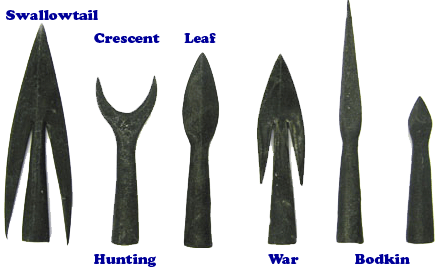
There are many different arrow types, used for specialist purposes, the most common are. Only war arrows are used within the campaign.
- Bodkins
- Square or needle bodkins give low damage but high penetration. (penetrate all armour types unless otherwise restricted)
- War arrows
- Use against non-metal armoured warriors, they cause more damage as they are larger and may break off in the body.
- Swallowtail
- Used for large animals, high stopping power but heavy and innacurate. They have little to no penetration capability against armour (excluding natural hide) or natural scales.
- They are cutting weapons at all ranges.
- Crescent
- Used for knocking birds and small animals in trees, without impaling them to a high branch. They are slashing at all ranges.
- Leaf
- Normal hunting. They are slashing at all ranges.
Crossbows
Light and heavy crossbows are counted as only one skill.
Crossbows are easier to use and thus require less training than hand bows as once cocked they do not take any effort to maintain the pull, additionally they may be aimed by resting on a handy surface.
If a crossbow is supported such as resting on a rock then an additional +1 to hit is gained.
As crossbows have a pull of 150 lb. or more they need assistance from a mechanism to cock them. This will vary from a simple foot stirrup for a pellet crossbow through a spanning lever for a light to a full windlass for a heavy crossbow. This affects the time to span the bow and hence reduces the number of shots per round.
A crossbow will have a pull of 250lbs for a light one up to 1000lbs for a heavy, whereas a longbow would have an average pull of 80-100lbs and up to a maximum of 150lbs.
Pellet Crossbow
A one handed crossbow. These can be cocked by hand. These use small bolts that only cause stamina points.
Light Crossbow
Crossbows with a pull of under 250lb. These require a foot stirrup and belt hook or a spanning lever to cock the weapon.
Heavy Crossbow
Crossbows with a pull of over 250lbs. These require a windlass to cock the weapon.
Grenade
Max distance for a 1/2 lb flask = 90' + 10' x strength.
