The art of Magic & Prayers
Magic Types
There are 2 types of magic, elemental and god given. Although these types may produce similar results they are in no other way related. The power for all spells comes from the planes in the heavens, different planes provide different powersBefore we can discuss the powers and types of magic we first need to get a grounding of how the multiverse is made up.
The planes of existence
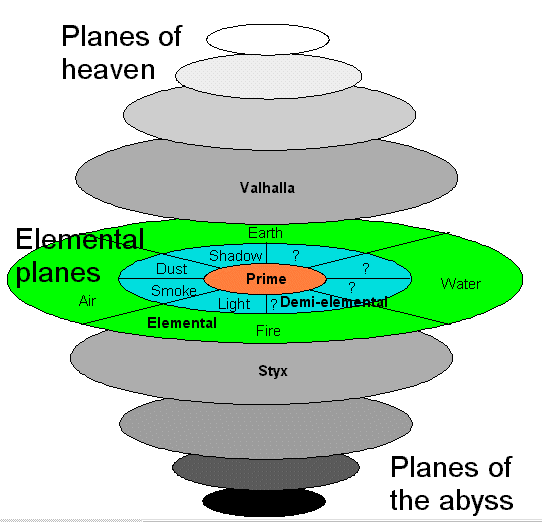
Thus we can see that the prime material plane where the characters dwell is actually part of the elemental planes. These planes comprise the four basic elements at the periphary surrounding the demi-material planes of dust, smoke, shadow and dozens of others which in turn surrounds the prime material plane. Following the logic it can be seen that the prime material plane is in fact simply a mish mash of all the elemental planes put together. No one elemental plane dominates the prime material, creatures which inhabit the other planes often find it relatively easy to slip betweeen the boundaries in to the adjacent planes.
The planes of heaven and hell exist in another dimension to the elemental planes which is why the priestly and elemental magic do not co-exist. In the diagram power for a character can only flow vertically or horizantally between the planes but not both.
Surrounding the planes are the ethereal and astral planes. They have a 1:1 relationship with the other planes, all points existing in all the planes however travel is at different speeds.
Ethereal
It is possible to see from the Ethereal to the Prime plane but not normally vice versa. In the ethereal you may travel in any direction as there is no ground. Equivalent prime material plane speed is (10 + intelligence) mph. Speed of travel is controlled by thought. Unconscious characters may be carried at normal speed but if they are awake their thinking brain controls their maximum speed.
Astral
The astral plane may contain structures of its own and is compressed in space compared to the prime material plane. Equivalent prime material plane speed is 10 x (10 + intelligence)mph.
Priests
Priests cast their spells by invoking the will of their god or other extra-planar creature as is their whim. Priests are able to cast their spells as long as they are not cut off from their god. their power comes from the planes of heaven and hell which can be reached with equal ease from any of the material planes. The problems come only when the priest is further removed from their gods plane than normal. The further down into the abyss a priest travels the less the power of the gods from the upper planes and the greater the power of the gods from the lower planes.Elemental / Old magic
Elemental magic belongs to wizards and the creatures of the elemental and demi-elemental planes, including those that choose to reside on the prime material plane. This includes creatures such as dragons, mephits...These can perform their powers anywhere on the elemental planes. They employ their powers by direct manipulation of the elemental forces and channelling the forces from their home plane.
Wizards have more problem than priests when travelling towards heaven or hell as their powers are designed to work within the elemental planes and not pass the boundaries in the vertical direction. Rather than preventing the mage casting the more powerful magics however (as happens to priests) it reduces the level of spell available to him.
Daily use
Casting
Spell casting creatures cast spells by using up power points (PP). Any spell a character knows may be cast provided the requisite power points are available. The higher the level of the spell the greater the number of power points required.| Spell / Prayer Level |
Power points |
|---|---|
| 1 | 1 |
| 2 | 2 |
| 3 | 3 |
| 4 | 5 |
| 5 | 7 |
| 6 | 9 |
| 7 | 11 |
| 8 | 14 |
| 9 | 17 |
Each spell/proyer has a difficulty factor associated with it which must be reached before the spell will work as planned. The base difficulty is
10 + spell/prayer level
However rolls lower than the skill level only mean that the spell was not as effective as expected, the fireball will be cooler or the charm easier to throw off
The spell difficulty is rolled against the highest power level of the spell using the skills in the normal way.
Wizard
Intelligence + casting ability + 2d8
Priest
Willpower + Faith + 2d8
If it has two levels such as Elemental and Force then the one in which the caster has the lowest power over that required is used.
Factor modified by casting success
Each spell has a default attribute which will be affected by the roll. The difference between the difficulty and skill rolled is checked against the appropriate table to determine the effect.
The order of priority is
- Damage
- Saving throw
- Duration
- Area
- Range
- For damage & duration use the spell damage table,
- For area, range use the altering spells table
- For saving throw use the success level table
If a spell duration is L0 hours/turns/... and a bad skill check (-2) is made it does not reduce to zero, instead count the hours as 60 minutes and reduce the time by the factor used for altering spells.
e.g.
1 hour = 60 minutes -> 40 minutes -> 25 minutes -> ...
1 Turn = 10 minutes -> 6 minutes -> 4 minutes -> ...
A bodge means the casting went wrong (normal bodge save vs level allowed)
Saving throw
Against spells or prayers the default saving throw is
10+spell levelProblematic casting
Restricted casting
Mages and priests sometimes are captured and tied up or gagged (or both). In these circumstances it may still be possible to cast a spell or prayer however they take a penalty to their skill.
Mages need a feat to be able to attempt mumbled or silent casting and then need to roll a saving throw based on 10 + spell level. If the throw fails the spell simply does not work.. Priests have an easier time as gods do tend to want their priests to carry on the good work (or evil deeds). Priests still suffer a penalty to the casting skill but do not have to roll a save to see if the prayer fails.
The penalties for bound and gagged are cumulative.
Spell casting in combat
Spell casting is difficult at the best of times, requiring intense concentration to phrase the words and complete the somatics correctly. These problems are bad enough when standing still in silence on a solid floor: attempting to perform spells in combat where the din of battle pounds your ears, the horse your sitting on refuses to stay still and the next spear is likely to be directed at you is almost impossible. Fortunately heroes take these things in their stride (you are a hero aren't you)If in direct melee it is impossible to cast a spell that takes more than 2 segments to perform. Longer than this and that spear will have an intimate knowledge of your entrails.
Prayer casting in combat
Priests have a slightly easier time of it than wizards as they are using the power of their god not the arcane forces. Gods are less particular about the verbal and somatics components of prayers. If a priest screams in pain in the middle of calling for divine help the god may even be inclined to help more. If the prayer is stopped though it will certainly fail.The priest is able to finish the prayer on an endurance save of
5 +1 per SP
Casting whilst moving
Casting in difficult circumstances such as on a horse frequently disrupts spells. The chance of failure depends upon the movement in the ground (or mount). A dexterity+riding skill roll must be made
(Priests gain +1 on their rolls as the god is not as particular)
Dex+Riding >= 12 + speed factor + spell level
Casting from a book.
A spell that you have known in the past but currently have forgotten can be cast directly from a spell book. It takes a round of preparation per two spell levels to read through and digest the spell immediately prior to casting. Of course you also need the book open and present (and thus in harms way) to read from.Rest & Recovery
Power points are recovered by sleep and rest. A full nights rest (8 hours) will recover all lost points. Shorter rest periods enable a character to recover only a percentage of a characters full capability as shown below.| Hours of sleep |
Percentage recovered |
|---|---|
| 4 | 20% |
| 6 | 50% |
| 8 | 100% |
After resting characters need to spend time reading their books or praying to their god.