Armour
Armour absorbs damage from successful strikes and deflects those blows that would have made a glancing blow. Armour is split into 3 varieties which perform different functions. Different weapons work best against different types of armour. Chain mail if almost proof against a slashing sword blow yet provides little protection against a mace, or other bludgeon weapon, similarly war arrows are designed to pierce chainmail splitting the rings. Plate armour, the most highly sought after may be proof against arrows at long range and swords but maces transfer the shockwave to the internal organs pulverising them without touching them and the battle-axe spike backed by a heavy head pierces plate armour like butter.
- Body armour reduces any damage.
- Helms & Breast Plates reduce damage to the vital areas.
- Shields help to parry a blow, preventing the body being hit.
Armour Type
|
Padded |
Boiled Leather |
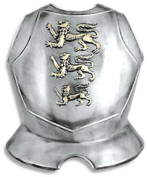
Metal breast plate |
Scale |
Mail Hauberk |
||||||||||||||||||||||||||||||||||||||||||||||||||||||||||||||||||||||||||||||||||||||||||||||||
|
|
|
Plate Armour |
||||||||||||||||||||||||||||||||||||||||||||||||||||||||||||||||||||||||||||||||||||||||||||||||||
|
|
|
||||||||||||||||||||||||||||||||||||||||||||||||||||||||||||||||||||||||||||||||||||||||||||||||||
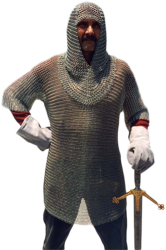
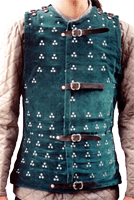
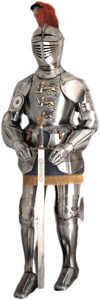
† Metal Armour that covers the lower arms makes manipulating a weapon more difficult which causes a -1 to hit.
‡ Minimum strength is adjusted by your size bonus ( melee attack ) and is compared to the racial norm.
§The maximum dexterity is increased by 1 for each 2 points of strength the character has above the minimum needed to use the armour
* Metal add ons may redue your base armour class. Approximately -1 per plate. They need at least padded armour underneath.
# Includes spells with physical effects and missiles. Note that the effects of some spells will curl around a shield (e.g. fireball) or go straight through it (e.g. lightning bolt) thus halving or negating its effectiveness. The bonus assumes you have spotted the incoming and are trying to take cover, if not then the bonus is halved (to zero for a buckler).
Armour location
| Location | Roll |
% of body |
Effect of Wound Point. |
|---|---|---|---|
| Head | 10 |
5% |
Stun save (Endurance). Int/Will/Alert at -1 |
| Shoulder & upper arms | 9 |
10% |
Reduces hand activity skills by 1d8 |
| Upper torso | 6-8 |
30% |
-1 to all skills |
| Lower Torso | 3-5 |
20% |
-1 to all skills |
| Thighs | 2 |
20% |
Any WP reduces speed to half |
| Lower arms / Shins | 1 |
15% |
-1 to hand skills or 1/2 speed |
Note : Most non-naturally armoured monsters do not cover their lower arms / shins with anything more than light leather as this would restrict their movement.
It is assumed that any armoured character has light leather on areas not covered by something better, there are no penalties for this.
Helms
| Helms | Alertness Modifier | Head Coverage |
Cut | Thrust | Bludgeon |
|---|---|---|---|---|---|
| Leather | 0 | 60% | 1 | 1.5 | 1.5 |
| Boiled leather | 0 | 60% | 1/2 | 3/4 | 1/2 |
| 0 | 80% | 1/4 | 1/2 | 1 | |
| Small | 0 | 70% | 1/10 | 1/5 | 1/4 |
| Medium | 0 | 80% | |||
| Great | -2 | 100% | |||
| Bascinet | -1 | 100% |
Creatures with helms that are struck and suffer damage must make an Stun (endurance) save. Most Helms provide better armour reduction than normal as they are designed to protect a sensitive area.
Magical damage
Damage from magic is not generally absorbed by armour unless the damage is of a specific type (e.g. bludgeon).
- Padded prevents 1/2 damage against cold.
- Full plate will provide grounding for a lightning attack, the wearer only takes 1/5 damage.
Armour effectiveness
Physical Weapon damage
Hard armour (Boiled / Plate) provides +2 protection against magical fire / cold / acid, the other types catch fire or soak up the acid.
Damage factor |
Damage taken | Damage pattern |
|---|---|---|
2 |
Double damage | x2 |
1.5 |
Plus 50% damage (round down) | x1.5 |
1 |
Normal damage | X X X X |
1/2 |
Take every 2nd point | - X - X - X |
1/3 |
Take every 3rd point | - - X - - X - - X |
1/4 |
Take every 4th point | - - - X - - - X - - - X |
Always ignore damage before taking any when wearing armour, this reflects the better base absorbtion of thicker armour.
Thus plate against a sword only takes a fifth of the damage so the character only suffers the fifth point taken
e.g.
- A sword does 4 points - The character suffers 0 points
- A sword does 5 points - The character only suffers 1 point
- A sword does 11 points - The character only suffers 2 point
However against a club it only absorb half the damage so :
- A club does 5 points - The character suffers 2 points
- A club does 11 points - The character suffers 5 point
Armour has a different effectiveness against each weapon style. There are three types of weapon
- Slashing (e.g. swords, axes)
- Bludgeon/Chop (e.g. maces, hammers, clubs)
- Thrust/Piercing (e.g. spears, daggers, arrows)
Each fighting style is more or less effective against different armour. Slashing swords are easier to use and great for parrying but almost ineffective against chainmail or better armour, maces and hammers smash the force of the blow through armour without puncturing it, the shockwave causing the damage whilst piercing weapons puncture the armour.
Most propelled piercing weapons puncture armour and cause half damage as wounds, melee piercing weapons cause the opponent to expend more stamina dodging the blows as they know that their armour won't deflect the blow. Remember that if an arrow pierces the mail much of the force of the blow will have been dissipated and it may well just get caught in the padding underneath.
Body armour
Armour will cover different areas of the body depending upon the type. All armour cover the major critical areas i.e. the torso, but as you move up in quality it will cover additional areas such as upper arms, hands, upper legs, and eventually the whole body. Helms are included of the appropriate type but are often supplemented with greater protection.
Most towns do not permit the wearing of armour within the walls unless you are noble, have been given the freedom of the town or are part of the guard. It must be packed up before entering the gates.
Wearing armour helps you absorb damage, the amount absorbed depends upon the weapon type, bludgeon, slashing or piercing. Any but the lightest will affect your athletics ability.
Availability
Most places only stock armour for typical humans off the shelf, anything else will have to be made specially or altered from existing stock.
Flexible
Flexible armour such as leather or chain helps against slashing weapons as it spreads and distorts with the force without penetration. Against bludgeon weapons it is less effective as much of the impact shock will penetrate and pulverise internal organs.
Hard
Hard armour such as boiled leather or metal chest pieces are more effective against bludgeon weapons as the impact is spread over the whole body.
Armour descriptions
Leather
This is a supple thick leather
Padded
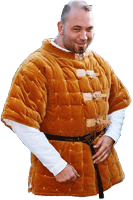
Padded or quilted Padded armour is constructed of an outer fabric, 2 layers of padding fabric and a lining fabric, stitched together with either horizontal, vertical, checked or diamond patterning.
>Boiled Leather
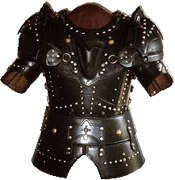
This is multiple smaller harder pieces of leather sewn or riveted together providing protection to the upper half of the body. Triangular or half diamond studs may be present turning it into studded leather.
This is light mail which either was worn as a hauberk covering the torso, upper legs and upper arms or as a full suit. Although heavy it is flexible allowing and the weight is well distributed (shoulders, arms and waist if a belt is worn) causing a minimal restriction to movement. It is designed to deflect the glancing blows of swords and is an excellent defence.
Mail may be bought off the shelf, it causes a -1 dexterity modifier but is 10% cheaper. Mail made to measure has no modifier.
Scale
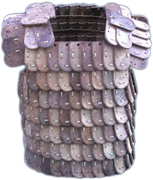
Scale armour comprises many small scales (often of iron but varied according to the material available from cuir bouilli to horn ) attached to a backing material of either leather or cloth.
Scale armour offers the same protection from blunt attacks as mail. It is also cheaper to produce but it isn't as flexible and doesn't offer the same amount of coverage.
Coat of plates / Plate mail
A coat of plates is a hauberk over which is a leather coat which has solid plates riveted in to provide protection against bludgeon weapons, longbows and crossbows. It is solid yet more flexible than a single piece breastplate so doesn't hamper movement as much
Plate mail is a suit of full chain with a solid breast plate and limited plate on the front of the arms and legs. It requires a squire to help you put it on.
Plate armour
This is a fully interlocking made to measure suit of armour plates providing complete protection to the whole body. Only master armourers can make plate armour, even then it can take up to 6 months with several fittings required. Be careful not to put on any weight or the armour will no longer fit.
It requires 30 minutes and a squire to help you put it on. You cannot sleep in plate armour.
Plate armour is immune to arrows (except in special circumstances such as if the arrows go through the cracks).
Helms, Breast Plates, Legs and Arms
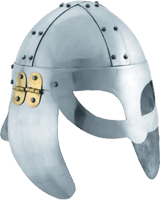
Helms are worn to protect the vulnerable head area. The absorption of the helm is only considered when a wound is done directly to the head. With the covering of the head the perception of the person wearing the helm is reduced.
Small Helm |
Medium Helm |
Great Helm |
Bascinet |
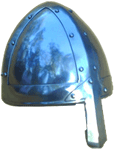

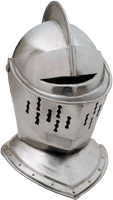
Helms only cover a portion of the head dependent upon the type of helm. When a strike to the head occurs you must determine whether it hit the helm or your open face. If the strike was to the open face then the helm offers no protection.
Helms are so thick that they convert all wound points that would pass through to stamina points, however the head is a critical location so all damage that passes trough is doubled.
Any strike to the head may stun a character.
If the save is dreadful then the character has been knocked out for a round then starts the wake up procedure.
Breast Plates are worn to protect the vulnerable chest and abdomen area. The absorption of the plate is only considered when a wound is done directly to the chest. They only add to the protection of light leather, padded and mail body armour, other armour types already include a solid chest plate or equivalent.
Leg and arm protection was sometimes added separately which may be of a different type to the main armour. Typically it is plate armour covering only the front vulnerable part of the limbs.
Shields
Shields make it harder to hit somebody. By training in their use it is possible to increase their effectiveness.
Although shields provide coverage they can be large, bulky and unwieldy which makes it harder to do other tasks, medium and bigger shields reduce a character's dexterity whilst large ones also reduce their attack skill as it is harder to reach the opponent.
Shield types
The Buckler
The arming sword and buckler was the most common combination for much of the middle ages in open battle as the speed and agility it gave outweighed the advantages of the greater coverage of a medium shield.
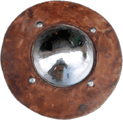
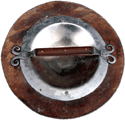
| The buckler was a a small round, usually metal shield which
could be hung from a belt. This type of shield was reserved for hand-to-hand
combat. The shields normally measured between 8 and 13 inches in diameter. They were held in a fist grip rather than strapped on like shields Many bucklers were pointed with a central tip or several smaller “teeth”. These points could be used offensively to great effect as well as aided in binding and deflecting an opponent’s weapon. |
  |
Medium shields
| Type | Description | 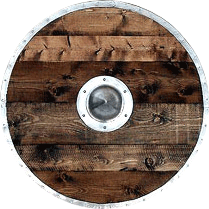 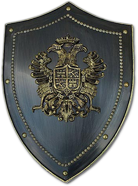
|
|---|---|---|
| Kite | Rounded at the top of the shield and tapered at the bottom providing body cover. | |
| Heater | Strongly associated with jousting knights. These are smaller as they compliment full suits of armor and are suited to horseback | |
| Targe | The traditional Scottish / Viking round shield |
Large Shields
Large shields are unwieldy and can only be used with spears, or other stabbing weapons such as short swords. They are not suitable for use with arming swords, axes, maces...
| Type | Description | 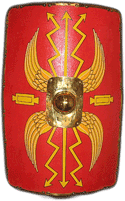 |
|---|---|---|
| Scutum | The Roman Scutum served the purpose to deflect missiles targeted at the soldiers, as well as protect them from the impact of hand held weapons wielded at them. The shields large size allowed the soldiers to form a shield wall that could protect them during an advance. | |
| Pavise | The Pavise was the shield used by Crossbow men. This type of tall shield provided protection when reloading his crossbow |
Shield construction
Shield construction started with the type of materials that would be required for a particular type of shield. These were chosen according to the style of combat and armor worn by the owner to determine the weight and style of the shields. Medieval shield construction used the following materials:
- Wood
- Animal hides
- Metal
A Medieval shield construction might also include a strap called a guige that allowed it to be slung over the knight's back when not in use or on horseback